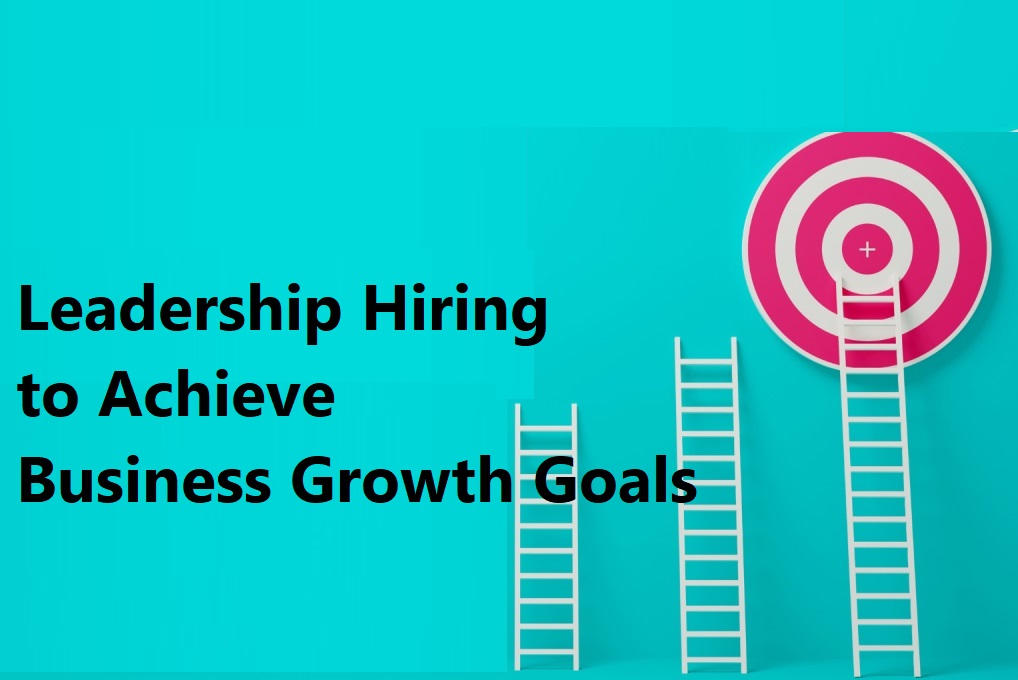
Growth does not necessarily fail because markets shrink or opportunities disappear. Growth fails when leaders cannot translate strategy into execution. Many companies invest heavily in marketing, technology, and expansion plans, yet they overlook one critical factor. The people leading those plans often lack the right capabilities for the next stage of the business. This gap shows up in delayed decisions, inconsistent team performance, and missed revenue targets.
Leadership hiring is a direct investment in business growth. When you align executive hiring with your growth goals, you reduce risk, improve execution, and build a leadership team that can handle scale. This is where experienced executive search firms play a key role. They help you move beyond resumes and focus on real business impact.
Below are seven well-defined ways to align leadership hiring with your business growth goals in a practical and measurable way.
1. Start with Clear Business Growth Objectives
Before you approach any executive search firms, define what growth actually means for your business. Growth can be expansion into new markets, improving profitability, launching new services, or building stronger internal systems.
Ask yourself:
- What are we trying to achieve in the next 12 to 24 months?
- What challenges are stopping us right now?
When your goals are clear, your leadership hiring becomes focused. A leadership search company can only deliver strong candidates when your expectations are defined. Without clarity, even the best executive hiring efforts can fail.
2. Conduct a Leadership Capability Audit
Before you start executive hiring, evaluate your current leadership team. Many companies skip this step and assume that hiring new leaders will solve all problems. In reality, growth requires both strengthening existing leaders and adding new capabilities.
A leadership capability audit helps you identify:
- Skill gaps within your current leadership team
- Performance gaps in key business areas
- Leadership behaviors that slow down decision-making
- Areas where accountability is weak
For instance, if your sales growth has stagnated, the issue may not be your product. It may be the absence of a leader who can build a high-performing sales structure.
Executive search firms often conduct leadership assessments to identify these gaps. This approach ensures your leadership hiring is based on real business needs rather than assumptions.
3. Match Leadership Profiles to Business Stage
Every stage of business growth requires a different type of leader. A common mistake in leadership hiring is selecting candidates based only on brand names or past titles. This does not guarantee success.
Consider how leadership needs change across stages:
In early-stage companies, leaders must build systems from scratch, take risks, and work closely with teams
In growth-stage companies, leaders must scale operations, create processes, and manage larger teams
In mature organizations, leaders must optimize performance, improve efficiency, and drive long-term strategy
If you hire a leader who is not aligned with your business stage, performance issues will appear quickly.
A skilled leadership search company evaluates candidates based on context. They assess whether a candidate has successfully handled challenges similar to your current stage. This makes executive hiring more precise and reduces failure rates.
4. Separate “Experience” from “Relevance to Growth Stage.”
A common mistake in leadership hiring is assuming that experience automatically leads to success. In reality, relevance matters more than experience.
A leader who has managed a large, stable organization may not perform well in a company that is still building structure. Similarly, a leader who thrives in a startup environment may struggle in a process-driven organization.
During executive hiring, evaluate:
- At what stage did the leader operate successfully
- What type of problems do they solve?
- Whether their past environment matches your current business stage
For example, if your company is moving from mid-scale to enterprise-level operations, you need leaders who have already handled complexity, compliance, and structured growth.
A leadership search company can help identify candidates whose experience directly aligns with your growth stage, not just their seniority.
5. Build Role Scorecards Instead of Generic Job Descriptions
Most job descriptions focus on responsibilities and qualifications. They do not define success clearly. This leads to mismatched expectations after hiring.
Instead, create a role scorecard. A scorecard defines:
- Key outcomes expected in the first 6 to 12 months
- Metrics that define success
- Critical challenges the leader must solve
- Internal and external stakeholders will influence
For example, instead of stating “Head of Sales responsible for revenue growth,” define specific targets such as increasing conversion rates, building a high-performing sales team, and improving pipeline quality.
This approach makes leadership hiring more precise. It also helps during interviews, as you can assess candidates based on their ability to deliver these outcomes. Executive Search Firms often use scorecards to align stakeholders and improve hiring accuracy.
6. Test Decision-Making Ability, Not Just Leadership Style
Interviews often focus on communication skills and leadership style. While these are important, they do not reveal how a leader will perform under real business pressure.
You need to assess how candidates think, decide, and act in complex situations.
Use scenario-based evaluations. Present real business challenges and ask candidates how they would approach them.
For example:
- How would you handle declining revenue in a key market
- How would you restructure a low-performing team
- How would you prioritize competing business goals
This approach gives you insight into their problem-solving ability, risk assessment, and execution mindset.
A leadership search company can design structured assessments that go beyond traditional interviews and provide deeper insights into candidate capability.
7. Create a Post-Hiring Integration Plan
Many companies assume that once a leader joins, they will automatically start delivering results. This assumption often leads to slow onboarding and missed opportunities.
You need a structured integration plan that helps the leader understand:
- Business priorities and growth goals
- Internal team dynamics
- Key challenges and opportunities
- Decision-making processes
The first 90 days are critical. During this period, the leader should focus on understanding the business, building relationships, and defining an action plan.
Regular check-ins and feedback sessions help ensure alignment and accelerate impact.
Executive Search Firms often support post-hiring integration to ensure that leadership hiring translates into measurable business outcomes.
Final Thoughts
Aligning leadership hiring with business growth goals is not a one-time activity. It is an ongoing strategy that requires clarity, planning, and expert execution. When your leadership team understands your vision and has the capability to deliver results, your business moves forward with confidence.
If you want to make leadership hiring more strategic and results-driven, working with the experienced Executive Search Firm Clearview Executive Search can give you a clear advantage. They bring market insights, structured processes, and access to top talent that is not easily available through traditional hiring methods.